WHERE IS OUR SHEPHERD?
Saint Cloud LIVE
Lauren Bruenig
March 20, 2026
Retirees press St. Cloud Diocese over pension shortfall
More than 1,400 current and former diocesan employees could see pension benefits cut by as much as 42% as plan participants demand transparency and a plan to restore the fund.
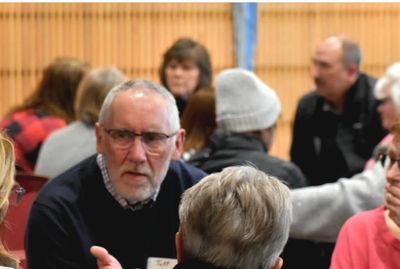
St. Cloud Diocesan Pension Concerns Group co-founder Jeffrey Kaster speaks with other pension plan participants about their concerns over the 42% funding shortfall during their Thursday, March 12, 2026, meeting in the St. Cloud Library.
ST. CLOUD — For 40 years, Mary Cheryl Opatz built her future around a promise. The longtime math teacher and principal at what is now All Saints Academy accepted lower pay than many public school educators, choosing instead to work in Catholic education where she could openly embody her beliefs — and rely on a pension offered through the Diocese of St. Cloud.
“I appreciated that I could every day live out my faith,” Opatz said. “Just even talking about a skirmish on the playground the way we talked about it related to our faith and to God and how we treat people.”
St. Cloud Diocesan Pension Concerns Group co-founder Mary Cheryl Opatz updates pensioners on the work the group is doing during a Thursday, March 12, 2025, meeting in the St. Cloud Library.
That promise was shaken Oct. 17, 2025, when a letter arrived informing about 1,400 current and former church employees that the pension plan is underfunded and could face cuts as high as 42%.
“I felt blindsided,” she said, after a long pause.
Opatz and Jeffrey Kaster, a former diocesan employee of more than 20 years, soon began organizing pension participants seeking answers. What began as a small gathering of about 50 retirees has grown into a group of roughly 220 former employees pressing church leaders for answers. Their demands for Bishop Patrick Neary and the Diocese of St. Cloud: transparency, representation on the pension committee and the creation of a capital campaign to help fully fund the plan.
Underfunded pension plan
The pension plan is currently funded at about 58%, leaving a projected shortfall of more than $80 million over the next 25 years.
The diocese participated in the Christian Brothers Services retirement plan since 1991, covering employees at parishes, schools and other Catholic organizations across its 16-county territory, officials said. However, multiple retirees said they have contracts that reference the Christian Brothers as far back as 1982, and they believe the deal or program with the Chicago-based company was restarted in 1991.
Diocesan officials say they were notified last summer that required contributions would increase because of the plan’s growing shortfall.
The shortfall is part of a larger issue involving Christian Brothers Service that affects pensions for thousands of current and former workers — particularly at Catholic schools — in the Diocese of St. Cloud and two other Minnesota dioceses, according to diocesan spokesperson Kristi Anderson. Nationwide, about 180 organizations and 40,000 people are impacted as the organization works to address an estimated $800 million funding gap.
Participants have limited recourse because the plans are classified as church pensions, meaning they are not subject to federal pension regulations and are not eligible for government bailout programs.
Elmer Kobbermann worked at St. Mary’s Catholic School in Alexandria for over 30 years. He voiced his frustration over the lack of communication from the St. Cloud diocese during a Thursday, March 12, 2026, meeting in the St. Cloud Library.
“Christian Brothers provided regular updates on the plan, but it was never disclosed that there was a substantial shortfall,” Anderson wrote in an email to St. Cloud LIVE. She said diocesan leaders trusted the organization to provide the information needed to manage the plan.
For Elmer Kobbermann, the issue is personal. He worked at St. Mary’s Catholic School in Alexandria from 1971-2004 and was principal when the diocese moved employees into the Christian Brothers plan. He helped staff enroll — a responsibility he said still keeps him up at night. “The frustrating part is that some of the schools had pension plans that were doing well, but they still had to join the (Christian Brothers) plan,” Kobberman said. Since learning about the shortfall, Kobbermann said he has felt angry and abandoned. Some retirees have lost spouses or live alone and now face serious financial hardship after reductions to their pensions, he said. “I can't stand by and not do anything when I see people that I worked with and respected being treated like they're being treated,” Kobbermann said, adding that he would not rule out legal action.
Diocese officials say they are continuing work to transition the frozen pension plan. In an update on Feb. 20, the diocese said a new account has been established through U.S. Bank to receive funds that will be transferred later this year from the Christian Brothers Employee Benefit Trust once a formal spin-off is completed.
Parishes, schools and the diocese continued to make monthly contributions for employees enrolled in the plan before it was frozen Dec. 31, 2025.
“The issue is very complex, and we understand there may be frustrations,” Anderson wrote. “The team is taking time to review the information with consultants and legal counsel to ensure diligence and great care before any decisions are made.”
‘Where’s our shepherd?’
After attending a diocesan informational webinar on Nov. 20, Jeffrey Kaster came away with a clear impression: “Trust us — you don’t get a say.”
The webinar took place more than a month after letters were sent to pension participants announcing the funding shortfall.
During the presentation, diocesan officials outlined their plan to address the problem: no new employees would enter the pension plan, current employees would stop earning additional benefits, and in mid-2026, the plan’s assets would transfer from Christian Brothers to a new trust overseen by the diocese and administered by a third party.
Until the transfer occurs, Christian Brothers will continue administering the plan and paying benefits.
As the webinar continued, Kaster grew increasingly angry. He felt participants were being talked at rather than listened to, and he bristled at explanations that pointed to the 2008 financial crisis and a failed 2020 hedge fund investment that lost about $149 million as reasons the plan became significantly underfunded.
“The Zoom call did not list any of the people that were on it, and chat was completely disabled,” Kaster said. “It was all top-down, and at the end it was almost like, ‘Trust us. We’ll make the best decisions for all of you.’”
He wasn’t alone.
Kaster and fellow retiree Opatz soon formed a support group for pension participants to share concerns and push for answers. About 50 people gathered at the St. Cloud Public Library in early December to share their stories.
One woman, who said she felt abandoned by the church, asked a question that stuck with Kaster: “Where is our shepherd?”
St. Cloud Diocesan Pension Concerns Group co-founder Jeffrey Kaster explains how he has connected with the media to raise awareness of the pension funding shortfall during a Thursday, March 12, 2026, in the St. Cloud Library.
As a former longtime diocesan youth minister and theology professor, Kaster said he feels called to both “walk with people who are hurting” and to push church leadership to be transparent and live up to promises made to its workers.
“Our biggest point is that the diocese is morally and legally responsible to meet its promises to its workers,” Kaster said. “Everything we do is aimed at that.”
The St. Cloud Diocesan Pension Concerns Group has grown to about 220 members as of mid-March. In recent months, the group has sent multiple letters to Bishop Patrick Neary and diocesan staff requesting greater transparency and a role in discussions about the pension’s future.
A Dec. 8 letter outlined four main requests: greater public communication about the problem, representation on the diocesan pension task force, listening sessions with plan participants and a capital campaign to fully fund pension promises.
Neary responded to one of Kaster’s emails in January, and Kaster said he has spoken with the bishop twice by phone. Still, members of the group say the conversations have not led to meaningful progress.
“We are aware of a group of retirees from schools and parishes who are working together to make their wishes known to the bishop,” Anderson wrote. “While particular demands have been made by this group … members of the task force are focused on finding solutions that benefit all plan participants, not just a certain subset.”
Anderson said the diocese has hosted webinars, sent letters and shared videos for pension participants in an effort to communicate clearly.
Meanwhile, the St. Cloud Diocesan Pension Concerns Group says it plans to continue pressing church leaders for more transparency and a path to fully fund the pensions.
Erosion of trust
For some diocese workers, the pension shortfall has become about more than retirement security.
They say it has shaken their trust in the institution they spent decades serving.
“I’m feeling kind of abandoned by the church that I dedicated my entire career to,” said Kaster, a diocesan English teacher, youth minister and youth director for more than two decades. “I’m not angry with the bishop right now. I’m angry with the system that didn’t have the oversight, it seems, to protect our retirement.”
For Kaster and others, the pension crisis comes after years of financial and institutional turmoil in the Diocese of St. Cloud, including its 2020 bankruptcy tied to clergy sexual abuse claims.
When Kaster first told his wife, Lynn, about the pension shortfall, he said she called it “another case of abuse.”
In an email to St. Cloud LIVE, Anderson said: “Bishop Neary has shared his deep concern for retirees, former employees and current employees who are affected by the pension shortfall. He understands the worry and pain this situation has caused and holds all those impacted close in prayer. The bishop remains committed to a careful and transparent process, acknowledging that this work will take time, even though that waiting is difficult. He wants the public to know that the diocese is working diligently with independent consultants and legal counsel to identify responsible and fair solutions for everyone who depends on the plan.”
Karl Terhaar, a STEM instructor at All Saints Academy, said the situation has also raised concerns among current employees about the future of Catholic education in the region.
Terhaar said the uncertainty has already affected his own plans. He now expects to delay retirement, and worries the situation could push other Catholic school teachers to leave for public schools.
March is typically when schools begin posting open positions, he said, and the pension uncertainty could influence whether teachers stay.
“If I had known years ago how bad this situation was,” Terhaar said, “I probably would have left Catholic education.”
All Saints Academy STEM Instructor Karl Terhaar called on the St. Cloud Diocese to take more accountability for the 42% pension funding shortfall and share the situation with the public during a Thursday, March 12, 2026, at the St. Cloud Library.
Additionally, he said many parishioners still don’t realize how serious the pension shortfall is. He believes the Diocese of St. Cloud should be communicating more openly with both pension participants and what he calls the “people in the pews.”
“Every parish bulletin and newsletter should say, ‘Yes, we have a shortfall, and it’s serious,’” said Terhaar, adding that he knew former diocesan employees who flagged issues with the system a decade ago. Instead, he said, many workers feel left in the dark. Despite the frustrations, Opatz said her faith has helped her navigate the uncertainty.“I have absolutely kept my faith in God,” she said. “But my faith in the Diocese of St. Cloud is being very challenged.”
What can be done?
Catholic employees across the country enrolled in Christian Brothers pension plans are facing similar uncertainty. In December 2025, a jury awarded $54.2 million to more than 1,100 former employees of St. Clare’s Hospital in Albany, New York, after finding hospital and church leaders failed to properly fund and oversee their pension plan.
The case is part of broader scrutiny over “church plan” pensions, which are exempt from many federal regulations that protect workers in traditional retirement plans.
“For years, St. Clare’s Hospital’s leadership misled workers about their pensions and mismanaged the pension program,” New York Attorney General Letitia James said in a statement. “No one should ever be deprived of the pension they were promised.”
The St. Cloud Diocesan Pensions Concerns Group does not have a lawyer nor has it filed anything in court, but members of the organization's leadership have met with attorneys from Robins Kaplan in Minneapolis multiple times, according to Mike Mullin, who serves on the group's legal issues committee.
While updating the St. Cloud Diocesan Pension Concerns Group on their legal options, Mike Mullin reminded pensioners that the diocesan lawyers represent the diocese, not them. The group met on Thursday, March 12, 2026, in the St. Cloud Library.
"We might pursue if legal action becomes necessary," said Mullin, who served as a Diocesan school teacher and administrator for over 40 years. "Now, the key word in that last sentence is 'if' and another keyword is 'might' ... but 'if' and 'might' can switch."
Mullin encouraged attendees at a group meeting on March 12 to collect their legal documents, especially if they are dated in 1982, in case the group does decided to hire a lawyer. “Our case is very simple … we believe there is an ethical responsibility, a moral responsibility and a legal responsibility for the diocese to honor our contracts, some going back 44 years," Mullin said.
Despite exploring its legal options, the pension plan participants are currently focused on advocating for their cause. Their primary tactics are working with the media to get more information about the situation out and pushing the St. Cloud Diocese to become more collaborative, Opatz said.
“People’s voices need to be heard, and that’s really what this is about,” Opatz said. “It’s like the diocese doesn’t seem to be willing to or interested in hearing the voices of the 1,400 of us.”
No longer alone
Since receiving the letter from the diocese, Mary Goenner has lost weight, lost sleep — and fears she could lose her home if her pension is reduced.
“I was shocked,” Goenner said. “I didn’t know what to do.”
Goenner spent nearly 40 years teaching music in St. Cloud and St. Augusta, raising two daughters as a single mother on a modest salary. What began as her first job out of college became a community she didn’t want to leave, even after receiving two offers for higher-paying jobs in public schools.
Now, she said, the sacrifice no longer feels secure.
For months after learning about the pension shortfall, Goenner felt alone.
Then Kaster reached out.
Dozens of pension plan participants formed small groups during their Thursday, March 12, 2026, meeting in the St. Cloud Library to discuss about how they felt about the funding shortfall and the diocesan response. About 25 people also attended the gathering via Zoom.
On March 12, she attended a meeting at the St. Cloud Public Library with dozens of other pension plan participants — while about 25 more joined virtually. It was the first time she had spoken with others facing the same uncertainty.
“What the St. Cloud Diocesan Pension Concerns Group is doing is important,” Goenner said. “Not a lot of people know what’s going on, and a lot of people are hurting.”
But sitting in the room that night, she said she felt something she hadn’t since the letter arrived.
She felt hope.
Timeline
• 1982: Multiple retirees say the have contracts referencing the Christian Brothers dating back to 1982.
• 1991: Diocese says it entered Christian Brothers plan (non‑insured church plan).
• Oct 2025: Under-funding letter mailed.
• Nov. 20, 2025: Webinar held.
• Nov. 21, 2025: Pensioners Jeffrey Kaster and Mary Cheryl Opatz decided to organize with other plan participants.
• Dec. 4, 2025: Listening session; 50 participants.
• Dec. 8, 2025: Kaster, on behalf of the St. Cloud Diocesan Pension Concerns group, writes a letter to Bishop Patrick Neary, requesting transparency and communication, pensioner representation on the diocesan committee, listening sessions and a capital campaign to address funding shortfalls.
• Dec. 19, 2025: Neary and Kaster speak on the phone about how the St. Cloud Diocese can better work with pensioners.
• Jan. 10, 2026: Kaster and the group meet to discuss next steps after getting no more information from Neary since the Dec. 19 phone call.
• Jan. 22, 2026: A survey of the approximately 150 group members finds 63% were interested in pursuing legal options and 80% want the St. Cloud Diocese to be more transparent.
• Jan. 26, 2026: The group emails Neary to request a meeting and listing the group’s demands.
• Jan. 27, 2026: Kaster receives a phone call from Neary in which he said the bishop acknowledged a lack of communication from the St. Cloud Diocese. Kaster ends the call under the impression that Neary would follow up shortly, but he said that did not happen.
• Jan. 28, 2026: A video and letter explaining the situation are received by pension plan participants. In earlier communication, the group requested a letter and video be shared with schools and parishes to help inform others about the situation.
• Feb. 3, 2026: Kaster says the group has not heard from the bishop about having a representative on the Diocesan Pension Committee.
• Feb. 20, 2026: The St. Cloud Diocese releases an update that says a new account has been established through U.S. Bank to receive funds that will be transferred later this year from the Christian Brothers Employee Benefit Trust once a formal spin-off is completed.
• March 12, 2026: St. Cloud Diocesan Pension Concerns Group, which now has 220 members, meets in the St. Cloud Library to discuss next steps.
• June 2026: The cuts will go into effect.
By the numbers
• Approximately 1,400 affected participants.
• Current funding level (58% as stated).
• Potential cut (up to 42%).
• Group size so far (about 220).
To learn more
• St. Cloud Pensions Concerns group: stcdiocesepensionconcerns.com
• St. Cloud Diocese: stcdio.org/christian-brothers/

Sign Up for Email Updates
Follow the latest updates on pensioners’ efforts to ensure that the St. Cloud Diocese fulfills its commitment to fully fund promised pensions.